For patients with serious burn injuries, getting specialized treatment quickly can mean the difference between life and death, recovery and disability, or a shorter hospital stay and a longer, more complicated recovery.
Researchers from The University of Texas Medical Branch (UTMB) led a national study published in the JAMA Network Open that explores how a person’s location can greatly affect how quickly they can reach that care.
Researchers contributing to the study are from UTMB; Shriners Children’s Texas; the Houston Methodist Institute for Reconstructive Surgery; and McGovern Medical School at UTHealth Houston.
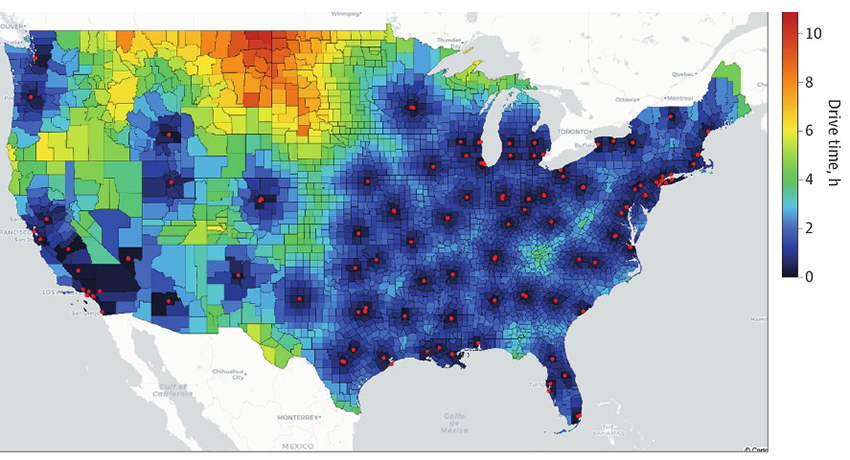
The national study examines access to verified burn centers across the contiguous United States. Researchers found significant geographic and economic disparities in travel time to specialized burn treatment facilities. While many Americans live within an hour’s drive of a verified burn center, residents of rural, small-town, and lower-income communities often face much longer travel times.
“Burn injuries require highly specialized care that is not available in every hospital,” said Philong Nguyen, a third-year JSSOM student who led the study as first author. “Understanding where gaps in access exist can help health systems and policymakers improve emergency care for the people who need it most.”
Mapping access to lifesaving care
Researchers analyzed data from 3,109 U.S. counties, representing more than 329 million people. Using population-based geographic data and road network travel estimates, the team calculated driving times from each county to the nearest burn center verified by the American Burn Association.
Verified burn centers provide specialized treatment for patients with severe burns, including critical care, surgery, wound management, rehabilitation, and long-term recovery services.
The study found that the average American, accounting for where people live, was located less than one hour from a verified burn center. However, the national picture looked very different when counties were examined individually.
More than one-third of U.S. counties had drive times longer than two hours, and nearly 9% had drive times exceeding four hours.
“Those numbers tell us that access is not evenly distributed,” said Joshua Wang, a John Sealy School of Medicine student. “Although most people live near metropolitan areas where burn centers are concentrated, many communities remain far from specialized care.”
Rural communities face the greatest challenges
The largest disparities appeared in rural and small-town communities.
Residents of metropolitan counties generally had the shortest travel times to burn centers, while those in rural and small-town counties often faced significantly longer drives. These longer travel times can create challenges during emergencies, when rapid treatment is critical.
The researchers also found notable regional differences. Counties in the Western United States experienced the greatest travel burden, with nearly two-thirds located more than two hours from the nearest verified burn center. In contrast, counties in the Northeast generally had the shortest travel times and the greatest concentration of specialized burn care facilities.
The findings reflect the realities of geography, population density, and the distribution of healthcare resources across the country.
Why time matters after a burn injury
Rapid access to burn specialists is important because early treatment can significantly influence outcomes.
Patients with serious burns may require complex fluid resuscitation, airway management, emergency procedures, surgery, and intensive wound care during the first hours after injury. Delays in specialized treatment can increase complications and worsen outcomes.
In many rural communities, patients are first treated at hospitals without dedicated burn centers. In those situations, emergency physicians and surgeons often must stabilize patients and make critical treatment decisions before transfer to a specialized facility.
The findings highlight the importance of ensuring clinicians in underserved areas have access to burn expertise, whether through transfer networks, telemedicine consultations, or other support systems.
Helping guide future planning
The researchers say the findings can help inform decisions about how burn care systems are organized and how resources are deployed.
Potential solutions include expanding telemedicine capabilities, strengthening regional referral networks, improving aeromedical transport systems, and identifying underserved areas that could benefit from additional burn care resources.
Because burn center verification is associated with improved patient outcomes, ensuring timely access remains an important public health goal.
“Our study provides an updated national picture of burn center accessibility,” Nguyen said. “By identifying where travel burdens are highest, we can help support efforts to reduce disparities and improve care for patients with serious burn injuries.”
The researchers hope the findings will contribute to ongoing discussions about trauma system planning and equitable access to specialized healthcare services across the United States.
Study authors are Philong Nguyen, Joshua Wang, Yousef Tanas, Sudhanvan Iyer, Kamryn K. Baker, Baijing Qin, Steven E. Wolf, and Jong Lee.